Choosing a telescopic hedge trimmer involves balancing several technical parameters, each of which can significantly impact work comfort and cutting quality, varying greatly from one model to another. Battery voltage, blade length, total weight with the pole extended: the differences between current models from Bosch, Ryobi, or Einhell warrant a comparative reading before any purchase.
36 V battery, gas-powered, or corded: performance differences on tall hedges
Older guides systematically pitted battery against gas, reserving the latter for heavy-duty tasks. The 2026 comparisons nuance this pattern. The 36 V platforms (Bosch, Ryobi, EGO) now reach a power level that covers the majority of private hedges, including dense and tall ones.
A field test published by Le Parisien on a Ryobi model on a pole indicates that a 5.0 Ah battery provides about 45 minutes of actual runtime, sufficient for continuous trimming of approximately 30 linear meters of dense hedge. With a 6.0 Ah battery, this duration increases to about 54 minutes. These measured runtime data in real conditions remain rare in general guides, which often only mention charging time.
To compare the three power modes for telescopic use, the available data allows for the following table.
| Criterion | 36 V Battery | Gas | Corded Electric |
|---|---|---|---|
| Runtime | 45 to 54 min (5.0-6.0 Ah) | Limited by the tank, often over 1 hour | Unlimited (mains) |
| Weight on pole | Moderate | Heavier (engine + fuel) | Light, but cable constraint |
| Noise and vibrations | Low | High | Low |
| Range | Total (wireless) | Total (wireless) | Limited by extension |
| Engine maintenance | Almost none | Regular (spark plug, filter, fuel) | Almost none |
The detailed sheets available on taille-haie-telescopique.com allow for a model-by-model comparison of these parameters, which remains the most reliable method for choosing one suited to the configuration of your garden.
Double action blade and tooth spacing: what determines the cut
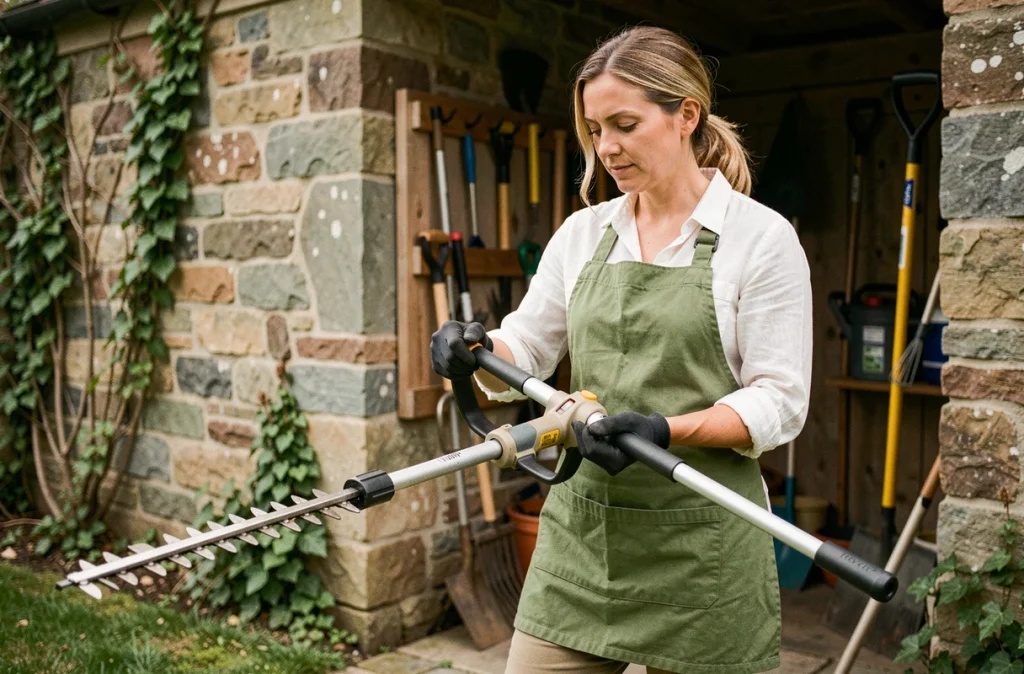
The blade length and type of cut directly influence the result on the hedge. A double action blade (both blades slide in opposite directions) reduces vibrations transmitted to the arms, a crucial advantage when the tool is held aloft for several minutes.
The spacing between the teeth sets the maximum diameter of branches that the hedge trimmer can cleanly cut. For dense hedges made of privet, laurel, or thuja with woody branches, a spacing greater than 16 mm is recommended. Below this, the tool risks jamming or crushing the branches instead of cutting them.
- Blade of 40 to 45 cm: maneuverable, suitable for narrow hedges and high finish work with a telescopic pole.
- Blade of 50 to 60 cm: covers more surface per pass but adds weight and reduces precision on angles.
- Tooth spacing less than 16 mm: reserved for young hedges or shrubs with fine branches.
- Tooth spacing greater than 16 mm: cuts semi-woody branches without straining the motor.
The choice of blade length also depends on the height of the hedge in question. On an extended pole, a long blade amplifies the lever effect and fatigues the arms more quickly. For hedges exceeding two meters, a 45 cm blade offers the best compromise between coverage and control.
Weight and ergonomics on telescopic pole: the limiting factor
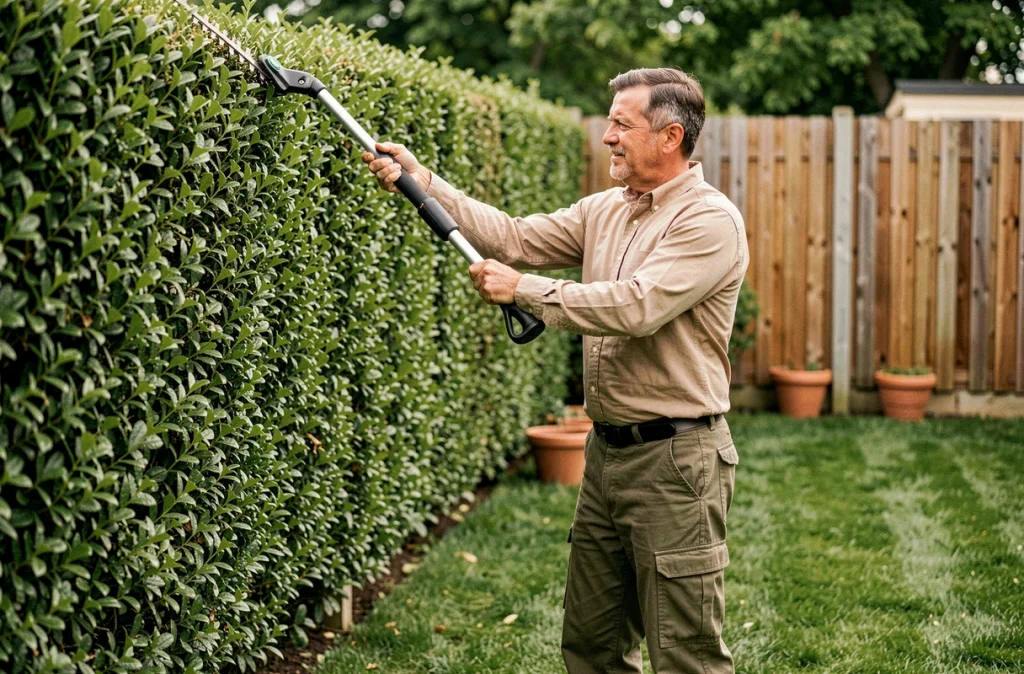
While motor and blade characteristics matter, it is the total weight with the pole extended that determines the actual sustainable working duration. A hedge trimmer on a pole exceeding five kilograms becomes cumbersome after twenty minutes of use at height, even with a harness.
Several elements influence prolonged comfort of use:
- The anti-vibration system, which limits muscle fatigue and joint strain at the wrists and shoulders.
- The presence of a weight distribution harness, often sold separately, which transfers part of the load to the torso.
- The adjustable cutting head, which allows for angle adjustment without changing body position, reducing awkward postures.
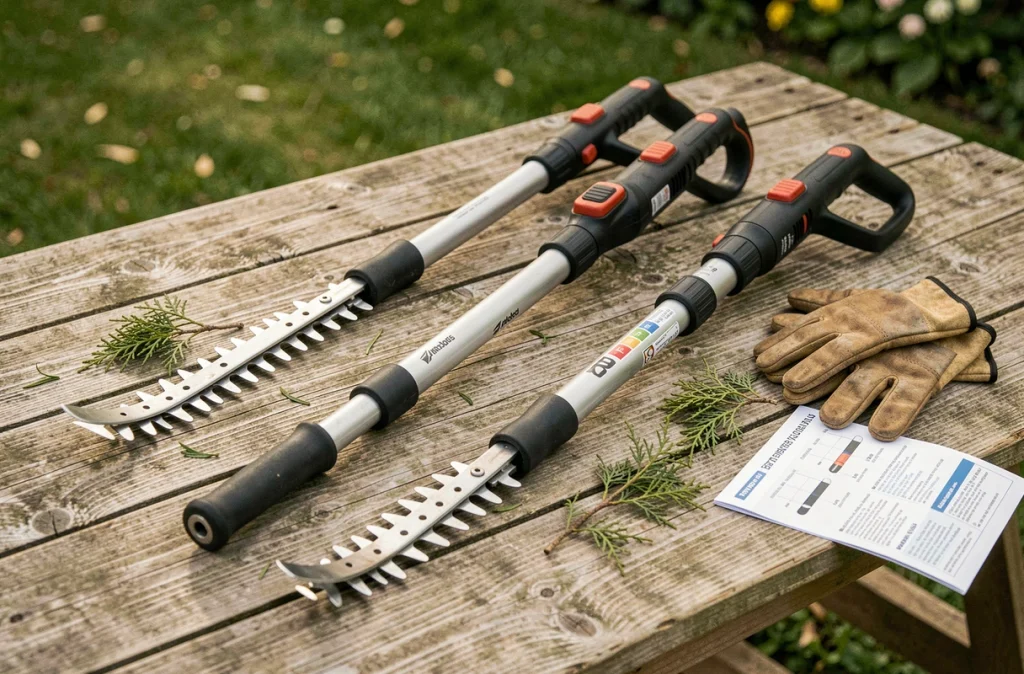
The Bosch, Ryobi, and Einhell models incorporate these elements unevenly. On the entry-level Einhell references, the harness is not always included. At Ryobi, the ONE+ 18 V platform offers lighter models but with cutting power lower than the 36 V versions. Weight remains the first criterion to check before power or runtime.
Telescopic hedge trimmer and trimming period: a regulatory constraint to consider
The French Office for Biodiversity recommends avoiding hedge trimming from March 15 to July 31, the nesting period for birds. This recommendation, although not penalized for individuals, is echoed by most local authorities and may condition the tool’s usage schedule.
In practice, the main trimming window is between September and February. Fast-growing hedges (laurel, privet) may require a second pass at the end of summer. This means that the tool should be sized for two to three sessions per year, concentrated over a few weeks, which puts into perspective the need for a gas model with very high autonomy for most private gardens.
A 36 V battery-powered telescopic hedge trimmer, equipped with a 45 cm double action blade and weighing less than five kilograms with the pole extended, meets the needs of the vast majority of residential hedges. The final choice hinges on the actual weight in hand and the availability of a compatible harness, two factors that only a hands-on experience or a detailed technical sheet can verify.