A parent who refuses to call after a fall because they don’t want to “bother anyone,” a neighbor who no longer goes out since the bus no longer serves their neighborhood: we encounter these situations well before discussing loss of autonomy. Services aimed at seniors are evolving to intervene at this early stage, where targeted support can change daily trajectories.
Several recent initiatives go beyond the sole logic of staying at home to aim for a richer social, physical, and psychological life.
Life paths of seniors: what the 2024 well-aging law changes
The law of April 8, 2024, concerning measures to build a society of well-aging and autonomy, establishes a framework that goes beyond the issue of care. It introduces obligations regarding the fight against social isolation, the right to connection, and the civic participation of elderly people. For families and professionals, this translates into services focused on quality of life, not just safety.
In practical terms, we see the emergence of programs that combine accompanied outings, discussion groups, and regular satisfaction assessments. The approach is no longer limited to checking if a person is eating and taking their medications. It incorporates what the person wants to do with their day, even when mobility declines.
To explore this type of daily-centered and flourishing-focused offer, you can access the Green Seniors website, which brings together services designed with this comprehensive support logic.
Personalized support for seniors beyond the home
Competitors are heavily focused on home automation and teleassistance. Their usefulness is not disputed, but these devices address only one need: physical safety. However, when discussing with caregivers, the first issue raised is often isolation, followed by loss of motivation.
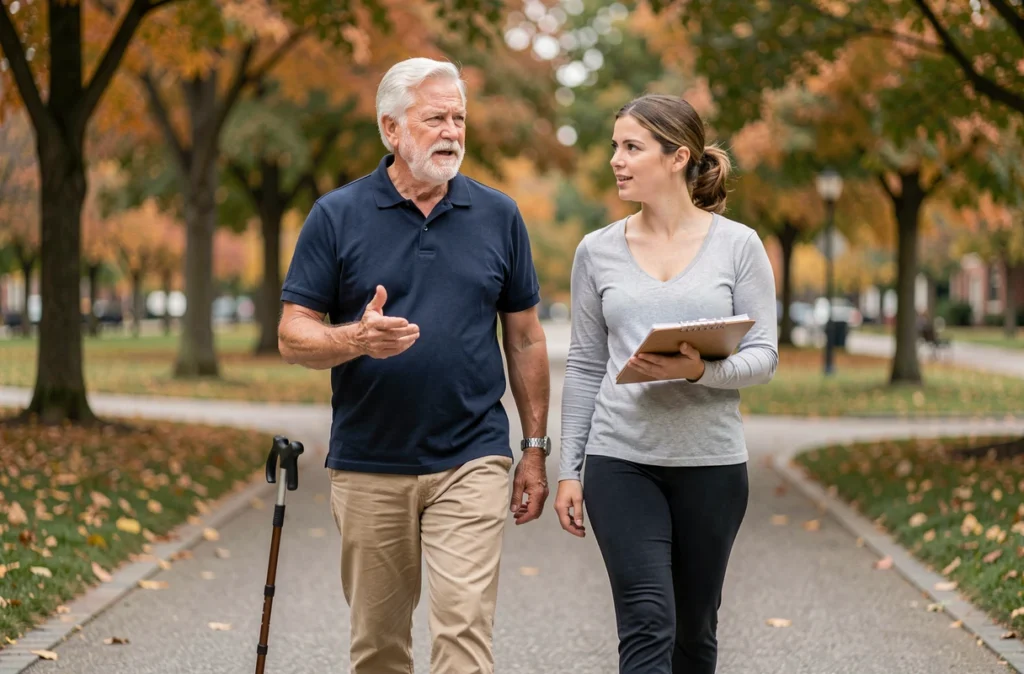
In 2026, the CNSA selected 5 innovative projects out of 152 applications submitted as part of its call for projects “Experimenting to support the evolution of the medico-social offer,” with over one million euros in financial support. These projects focus on adapting the offer to the life paths of elderly people, including respite times, psychological support, and active civic participation.
This change in perspective has practical consequences. An innovative service for seniors is no longer limited to installing a fall sensor in the hallway. It can take the form of an alternative family hosting program, small group cognitive workshops, or support for resuming volunteer activities.
Concrete solutions that go beyond the classic catalog
- Family hosting for seniors, which offers an alternative to nursing homes with accommodation at a licensed host’s home, in a shared living environment supervised by regular social follow-up.
- Mobile services in rural areas, which bring paramedical consultations, cultural activities, or administrative assistance directly to underserved municipalities.
- Peer support programs among seniors, where trained retirees assist individuals recently facing a loss of mobility or bereavement, based on the peer support model.
- “Life project” assessments conducted at home by social workers, to identify not deficits but desires and mobilizable resources.
These solutions share a common point: they place the person at the center of a project, not a protocol. Feedback varies according to territories and teams, but the observed dynamic shows that social connection remains the primary lever of autonomy for elderly people.
Transparency in nursing homes and senior residences: a lever for better choice
One aspect of the well-aging law now mandates the publication of operational indicators for nursing homes. Staffing ratios, absenteeism rates, and staff turnover will be made public. For families seeking accommodation solutions, this is a major change.
Before this measure, comparing two establishments relied on word of mouth or a one-time visit. With accessible data, one can cross-reference staffing ratios with the type of support offered. An establishment that is transparent about its indicators engages its credibility in a way that is unprecedented in the sector.
This transparency also applies to senior residences and certified home services. The citizen consultation “Aging in France today and tomorrow,” initiated by public authorities, invites users and caregivers to share their experiences. We are moving from a system where the senior receives a service to a model where they contribute to defining it.
Criteria to check before choosing a support service
- The qualification and stability of the team: high turnover undermines the trust relationship, especially for disoriented individuals.
- The existence of a personalized project reevaluated at least once a year, taking into account preferences and not just medical needs.
- The possibility to adjust services: a rigid service that does not adapt to the evolution of the situation (improvement or deterioration) becomes unsuitable within months.
Family caregivers and respite services: an underestimated need
There is much talk about the elderly person, but less about those who surround them daily. Family caregivers provide a significant portion of support, often without training or backup. Respite services, whether temporary accommodation or home intervention to free the caregiver for a few hours, remain underutilized.
An exhausted caregiver cannot provide quality support. Innovative services now integrate this reality by offering combined formulas: support for the senior and assistance for the caregiver in the same program. Exchange groups, specialized listening lines, and short training on daily gestures are part of this emerging offer.
The framework set by the CNSA and the 2024 law encourages structures to think in terms of a caregiver-care recipient duo rather than isolated services. This approach requires more coordination but reduces the breaks in care pathways that too often lead to hospitalization or emergency placement.
Support for seniors becomes more relevant when it moves away from a technological reflex to anchor itself in human connection, transparency, and consideration of the surrounding environment. The tools exist, and funding is being structured. The challenge remains to make these services known to those who need them, often the least connected.