Organising a memorable adult birthday party often starts with a detail that’s easy to overlook: the diversity of your guests. Some don’t drink alcohol, others need accessible facilities, and a few may have to leave before midnight. When you plan for these situations from the outset, the evening runs more smoothly for everyone, without anyone feeling left out.
Adult birthday party: planning an event where every guest matters
It’s easy to focus first on the theme, playlist or cake. The real starting point is getting to know your group. A quick questionnaire sent with the invitation lets you find out what guests need without asking them to explain why: food allergies, mobility requirements, drink preferences and preferred departure time.
This isn’t a medical form. Two or three open-ended questions are enough, included directly in the invitation. The idea is to give everyone a discreet way to share what would make the evening more enjoyable for them.
This approach draws on recommended event accessibility practices, which prioritise direct communication with attendees to confirm arrangements with the venue and suppliers. The result: you can adapt your plans in advance instead of improvising on the day.
Platforms such as https://www.omniz.net make it easier to coordinate the logistics of this type of event, particularly by bringing responses together and managing practical details.
Party venue accessibility: what to check beyond the entrance

When looking for a venue for a birthday party, we check the capacity and the price. Accessibility often comes down to one question: “Are there steps at the entrance?” That’s not enough.
Accessibility needs to be checked along the entire route, not just at the door. If the party is being held at a venue open to the public, check the route from the car park or public transport stop, the indoor passageways and the toilets. You can ask the venue for its public accessibility register, a document that venues open to the public are required to make available.
Here’s what’s worth checking before you book:
- The width of doors and corridors (a standard wheelchair needs at least 80 cm of clear passage, though wider routes are more comfortable)
- Whether accessible toilets are close to the party room, rather than on a different floor
- Whether the outdoor access route is well lit, especially for an evening party
- Whether you can set aside a quiet area for guests who may need a few minutes to themselves
Describing the access arrangements in the invitation is more helpful than simply saying “accessible”. A sentence such as “the room is on one level, and the accessible toilets are on the same floor” offers reassurance without being intrusive.
Alcohol-free bar and flexible timings: two ways to create an inclusive atmosphere
A successful birthday party is one where nobody feels left out. The proportion of guests who don’t drink alcohol varies from group to group, but their numbers are often underestimated. Offering only orange juice and sparkling water relegates them to the sidelines.
Putting together a festive alcohol-free bar
Alcohol-free cocktails made with the same care as the others can change the atmosphere. Think proper mocktails made with artisanal syrups, fresh herbs and homemade flavoured waters. The key is to serve them at the same bar, in the same glasses, without an “alcohol-free” label that singles them out.
You could also have a themed, entirely alcohol-free bar for part of the evening, presenting it as a creative choice rather than a restriction.
Making early departures easy without disrupting the party
Some guests have childcare or transport commitments, or simply get tired. Scheduling the highlights early in the evening means those who leave early won’t miss out. Plan the cake, speeches and main activity for the first two hours.
One practical tip: clearly state the cake-cutting time in the invitation. This gives guests who need to arrange their journey home a clear reference point and saves them from having to ask, which can feel awkward.

Decorations and logistics: cut waste without losing the festive feel
Adult birthday parties often generate more waste than people realise: disposable tableware, single-use decorations and food packaging. Recent event-planning guidance favours reuse, which reduces both the workload and the amount of rubbish.
- Use washable tableware instead of disposable items, or ask each guest to bring a plate or glass (the potluck concept works for tableware too)
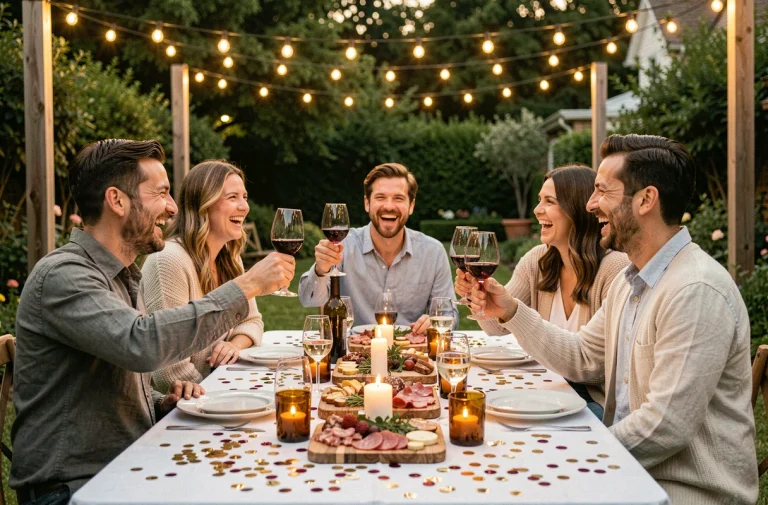
- Borrow decorations from friends and family or collect reusable items such as string lights, candles and fabric tablecloths
- Adjust food quantities to the number of confirmed guests, and prepare containers in advance so leftovers can be shared rather than thrown away
This approach doesn’t have to feel austere. A table set with mismatched real crockery and candles often has more character than disposable decorations from an Amazon bundle.
Noise and neighbours: precautions for a party at home
People often assume you can make as much noise as you like before 10 pm. That’s not true. In France, there is no nationwide time limit that automatically permits noise nuisance: the duration, frequency and volume of the noise also matter, including during the day. Excessive daytime noise is an offence just like excessive nighttime noise.
For a birthday party at home, a few simple steps can prevent friction. Let your neighbours know a few days in advance, give them an approximate end time and gradually turn the volume down as the evening goes on. If your building’s rules or a local bylaw sets specific hours, it’s best to check beforehand rather than discover the issue when someone rings your doorbell at 11 pm.
Ultimately, planning a memorable adult birthday party comes down to thoughtful preparation. The best memories rarely come from the biggest budget, but from an evening where everyone feels welcome, from the first cocktail to the last slice of cake.