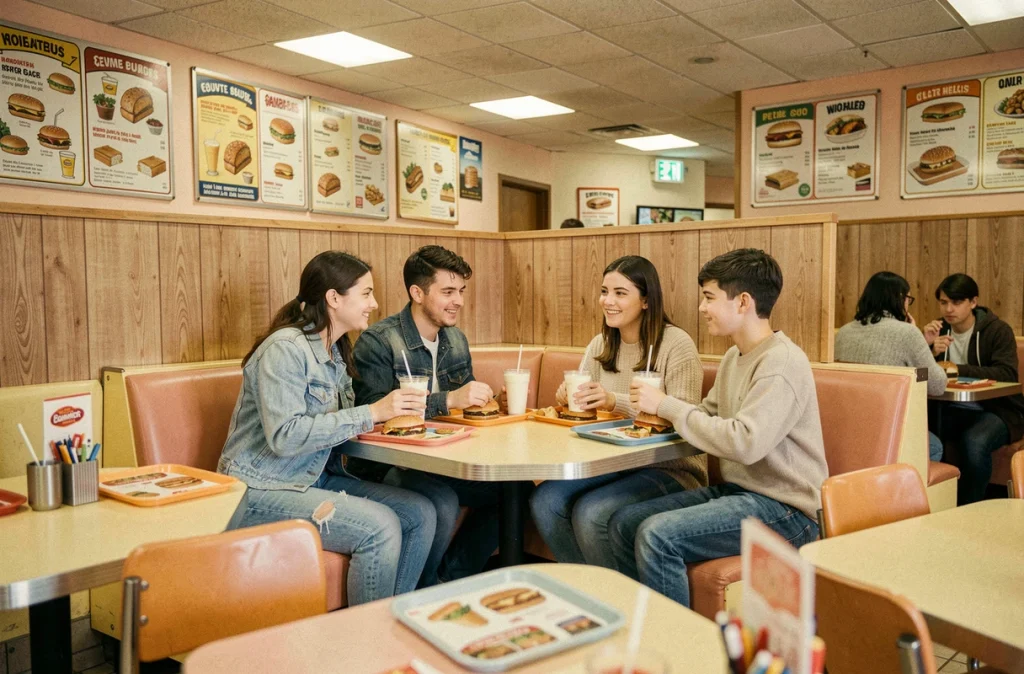
Flunch in partial liquidation, Courtepaille changing hands, Buffalo Grill rebranded, Quick absorbed by Burger King: the brands that marked family outings in the 1980s and 1990s have undergone an erosion over two decades that goes beyond mere nostalgia. Behind each closure lies a recurring pattern of fragility in the French chain restaurant model.
Economic model of French chains: structurally fragile profitability
The restaurant chains born between the 1960s and 1980s shared a common foundation: located on the outskirts, moderate average ticket, rapid turnover of tables. This model relied on high foot traffic to compensate for low margins. As soon as attendance declined, the equation turned upside down.
We observe that the profitability of chain restaurants remains among the lowest in the sector. Fixed costs (rent for large spaces, payroll, maintenance of industrial kitchen equipment) weigh heavily when revenue stagnates. Family brands like Flunch or Courtepaille, designed to capture the flow from commercial areas, have seen this flow fragment with the rise of snacking, delivery, and segmented fast-food concepts.
When we revive these memories of the restaurants that have disappeared in France, one observation stands out: these brands did not disappear due to a lack of notoriety, but due to an inability to modernize their operations without destroying their price identity.
Quick, Flunch, Courtepaille: three distinct trajectories of disappearance
Reducing all closures to the same scenario would be inaccurate. Each brand illustrates a different mechanism.
Quick: absorption by a competing brand
The Belgian chain Quick, established in France since the late 1970s, has had an atypical fate. Acquired by the Burger King group, its restaurants have been gradually converted under the new brand. Quick did not go bankrupt; it was erased. The Belgian brand retains a few outlets in Belgium, but in France, the transition to Burger King has erased the visual identity, flagship products (the Giant, the Magic Box), and the entire associated universe.
Flunch: the dead end of the cafeteria model
Flunch, launched in 1971 by the Mulliez group, embodied the popular cafeteria linked to Auchan hypermarkets. The concept (unlimited vegetables, hot dish at the counter, low prices) worked for a long time. The brand attempted to reinvent itself with cut-price formulas and the development of the Flunch Café concept, but the decline in attendance at traditional shopping centers weighed heavily.
Closures have accelerated in recent years, with restaurants shutting down one after another across the country. The cafeteria format in commercial areas no longer attracts families, who prefer alternatives perceived as more qualitative or more convenient.
Courtepaille: series of restructurings
Courtepaille, founded in the 1960s around the concept of wood-fired grilling by the roadside, has changed owners several times. Each change of hands has been accompanied by the closure of sites deemed unprofitable. The brand still exists, but in a reduced version that has little in common with the dense network that covered French national roads.
Judicial recovery and liquidation: a dynamic still active
The disappearance of restaurant chains in France is not solely a thing of the past. In 2025, the Baudaire Group, which operates nearly 180 restaurants under various brands, was placed in judicial recovery. This warning signal concerns the entire chain restaurant sector.
More recently, the management company of the Del Arte restaurant in Chalon-sur-Saône was placed in liquidation. This case illustrates a phenomenon we are encountering more and more: a brand can survive at the national level while its local franchisees fall. The confusion between the closure of a point of sale and the disappearance of a brand fuels a nostalgic narrative that does not always reflect the legal reality.
This mechanism of recomposition by franchisees deserves attention. Some brands do not die; they contract. They lose their least profitable locations, retain a core, and attempt a repositioning. Buffalo Grill, rebranded as Buffalo, is an example: the brand has changed its name, revised its menu and decor, but the network remains active.
Market polarization: why old brands will not return
The French chain restaurant market shows a clear polarization. On one side, recent, well-segmented concepts (premium burgers, poke bowls, Asian street food) targeting an urban clientele with a strong identity positioning. On the other, the old generalist brands that struggle to justify their existence against this fragmented competition.
Several structural factors prevent a return to the status quo:
- Suburban commercial areas, historically the playground of Flunch or Courtepaille, are losing attractiveness in favor of city centers and home delivery
- The cost of renovating an aging restaurant portfolio often exceeds the value of the brand itself, making acquisition unattractive for investors
- Consumer expectations have shifted towards offers perceived as more authentic, with short supply chains and a local identity, in contrast to the standardized model of historical chains
Concepts that used to wear out in ten or fifteen years now wear out in five. The pace of renewal in chain restaurants has accelerated to the point that a brand that does not invest massively in its transformation every three to five years loses its commercial relevance.
Hippopotamus, Léon de Bruxelles, La Criée: the list of struggling or disappeared brands continues to grow. Each carried a simple promise (meat, mussels and fries, seafood) that is no longer sufficient to justify the trip when the same product is available for delivery or in a better-rated independent restaurant online.
The restaurant chains that marked the youth of several generations of French people will probably not return in their original form. Their legacy is measured less in menus and dishes than in a collective relationship to dining out, one from an era when eating out with family was still a small event, not yet trivialized by delivery apps.