
Calculating the slope of a ramp involves juggling between two units that behave differently. The percentage expresses a ratio between height and horizontal distance, while the degree measures the opening of an angle. Transitioning from one to the other requires an accurate trigonometric function, the tangent, and not a simple rule of three. Confusing the two can lead to sizing errors on a construction site or in an accessibility file.
Tangent and arctangent: why the rule of three doesn’t work
The most common confusion is believing that 10° is equivalent to 10%. The relationship between degrees and percentage is not linear. It is based on the tangent of the angle, which is the ratio between the opposite side (the height or elevation) and the adjacent side (the horizontal distance).
The conversion formula is written as follows: slope (%) = tangent of the angle in degrees, multiplied by 100. To return to degrees from a percentage, the inverse function is used: angle (°) = arctangent (slope % divided by 100).
A technical point deserves attention: the horizontal distance is not the length of the ramp itself. The ramp length corresponds to the hypotenuse of the right triangle, not the adjacent side. Using the ramp length instead of the horizontal distance skews the result, especially beyond a 10% slope. To convert a degree to percentage without error, one must systematically reason on the horizontal projection.
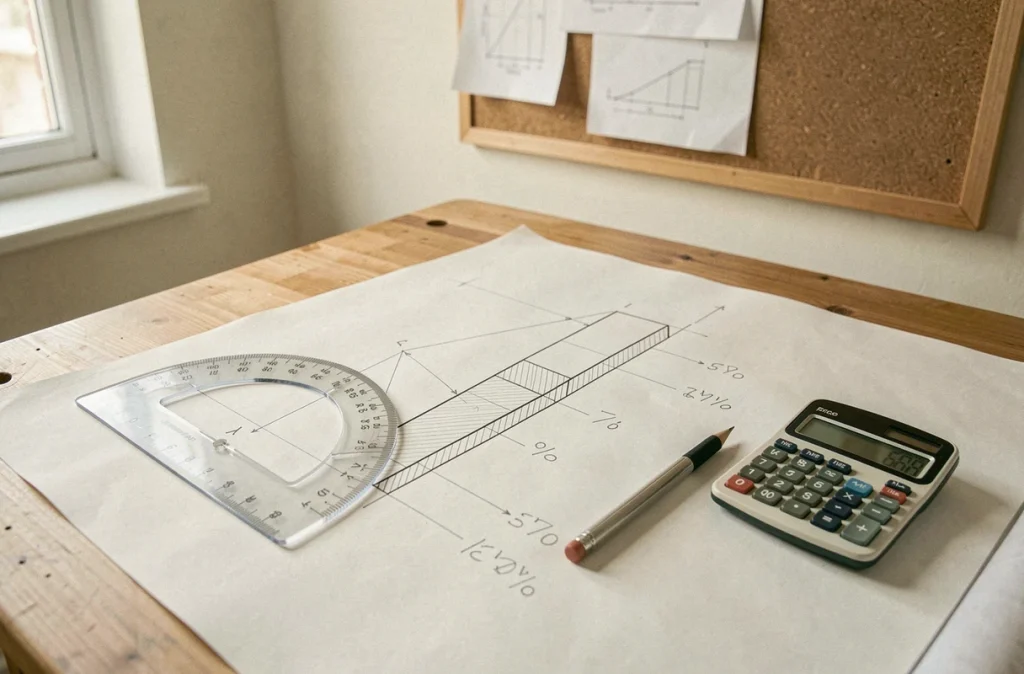
Correspondence table for degrees, percentage, and ratio
The values below illustrate the non-linearity of the conversion. The larger the angle, the greater the gap between degrees and percentage.
| Angle (°) | Slope (%) | Ratio | Common usage |
|---|---|---|---|
| 1.1° | 2 % | 1:50 | Sidewalk, parking |
| 2.9° | 5 % | 1:20 | Compliant accessibility ramp |
| 4.6° | 8 % | 1:12.5 | Accessibility exemption (less than 2 m) |
| 5.7° | 10 % | 1:10 | Easy mountain road |
| 11.3° | 20 % | 1:5 | Steep alpine pass |
| 19.3° | 35 % | 1:2.9 | Steepest street in the world (Baldwin St) |
| 29.7° | 57 % | 1:1.8 | Tiled roof (about 30°) |
| 35° | 70 % | 1:1.4 | Standard staircase |
| 45° | 100 % | 1:1 | 45° slope |
The most useful point to remember: 45° corresponds exactly to 100%, not to 50%. At 30°, the slope reaches about 57.7%, which regularly traps those who reason in direct proportion.
Reading the ratio 1:N in practice
The ratio complements the percentage and the degree. A ratio of 1:20 means that for 1 cm of elevation, the ramp travels 20 cm horizontally. This format is common in technical accessibility documents and road specifications.
For low slopes (less than 10%), the ratio remains close to the inverse of the percentage: 5% gives 1:20, 8% gives 1:12.5. Beyond that, the approximation no longer holds, and trigonometric calculation takes precedence.
Critical gaps between low slope and steep slope
Below 5°, the gap between the value in degrees and that in percentage remains modest. At 2.9°, the slope is 5%: the difference is small, and the linear simplification goes almost unnoticed.
In contrast, as soon as the angle exceeds 15°, the gap explodes. At 20°, the slope already reaches 36%, almost double the value in degrees. At 45°, it goes from 45 to 100%. This divergence accelerates further beyond: as it approaches 90°, the percentage tends towards infinity, making the unit unusable for a nearly vertical wall.
This property has a direct consequence on the choice of unit depending on the context:
- Ramp, road, and sidewalk slopes (generally less than 15°) are expressed in percentage because the values remain readable and comparable.
- Roofs and stairs (between 25° and 45°) use either degrees or percentage interchangeably, but degrees become more intuitive as the slope exceeds 50%.
- Embankments, rock walls, and extreme slopes beyond 60° are almost always measured in degrees, as the percentage loses all practical significance.

Ramp slope and accessibility thresholds: from calculation to compliance
The calculation of slope is not an abstract exercise when it comes to accessibility. The standards for ramps intended for people with reduced mobility set precise thresholds in percentage, not in degrees.
A compliant accessibility ramp does not exceed 5% slope in new construction. An exemption allows up to 8% if the ramp length remains less than 2 m. Beyond 8%, the ramp is considered non-navigable by wheelchair.
Translated into degrees, these thresholds seem low: 5% corresponds to 2.9° and 8% to 4.6°. The margin between compliant and non-compliant is less than 2° of difference. A measurement error or a misplaced rounding in the conversion can push a project into the non-compliant category.
Check the horizontal distance, not the ramp length
To validate the compliance of an accessibility ramp, the percentage is calculated with height divided by horizontal distance, not by the total length of the ramp (the hypotenuse). On a 5% slope, the difference between these two values is negligible. On an 8% slope, it starts to affect the result. On a non-compliant slope of 12% or more, confusing the two skews the diagnosis by several percentage points.
For a short ramp (less than 2 m in length), a laser level or bubble level measurement on the horizontal distance is sufficient. For longer ramps, a topographic survey or complete trigonometric calculation avoids approximations.
The data that conditions all the sizing of a ramp remains the height-horizontal distance pair. The degree serves as an intermediate conversion tool, the percentage as a unit of regulatory compliance, and the ratio as a common language on technical plans.