300 ml corresponds to 0.3 liters. The conversion is based on a division by 1,000: the milliliter is the smallest common subdivision of the liter, and the ratio between the two remains strictly decimal. In cooking, this operation occurs constantly, whether for measuring a broth, liquid cream, or a marinade.
Reading a measuring cup without distorting the measurement of 300 ml
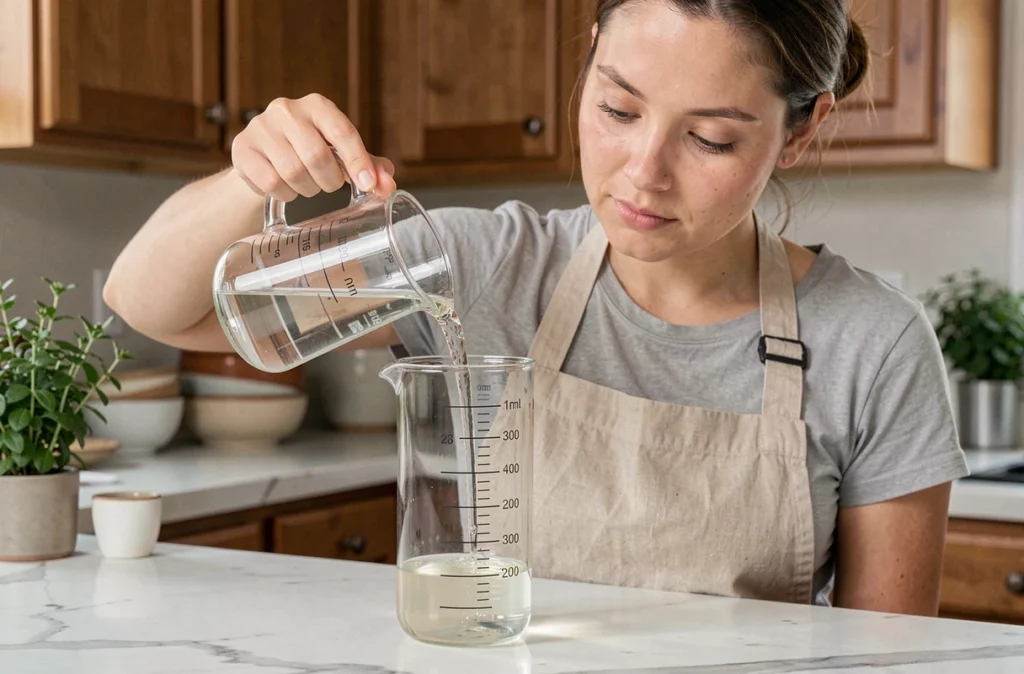
Most conversion errors in cooking do not come from the calculation, but from reading the measuring cup. A graduated container placed on a work surface and read from above gives a different value than that read at eye level. This offset has a name: parallax error.
To obtain a reliable measurement, the measuring cup must rest on a flat and stable surface. The reading is done by placing the eyes exactly at the level of the liquid, not above or below. The reference point to aim for is the bottom of the meniscus, this slightly concave curve that forms the surface of the water or any liquid in contact with the glass.
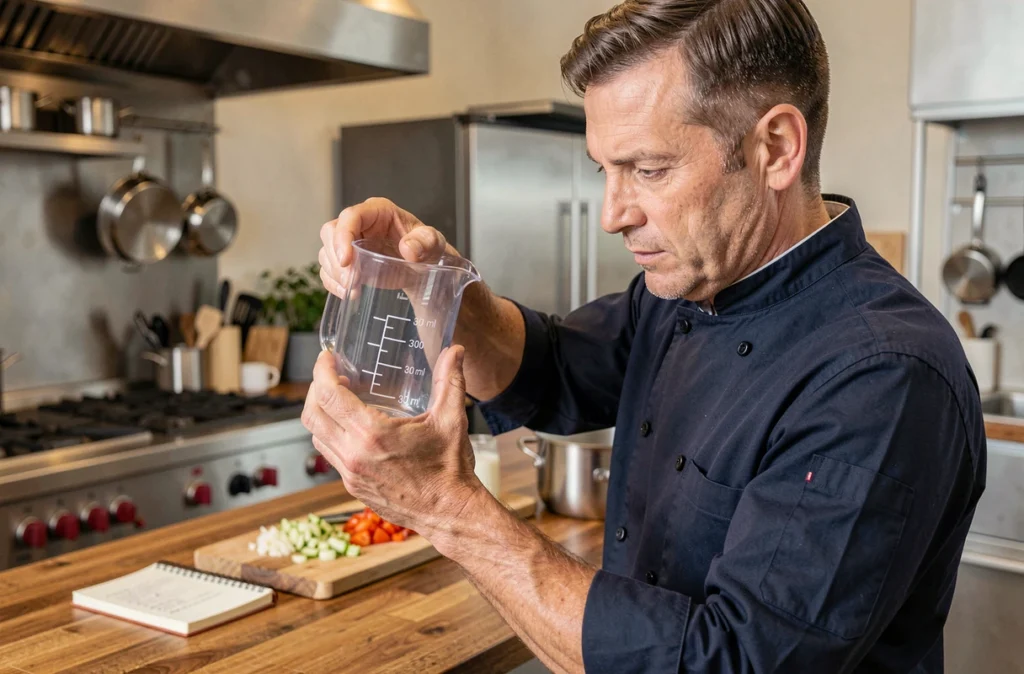
Holding the container in the air and tilting it towards oneself to read the graduation systematically distorts the result. The difference may seem negligible, but in a pastry recipe where liquid proportions determine the texture, a few milliliters too much or too little can change the consistency of a dough or cream.
The method to convert 300 ml to liters using a measuring cup remains arithmetically simple, but the reliability of the result depends primarily on this reading gesture.
Conversion ml to liters: the decimal logic applied to volumes
The metric system organizes volumes on a decimal scale. 1 liter equals 1,000 milliliters. Each transition from one unit to another involves moving the decimal point.
To convert milliliters to liters, you divide by 1,000. Thus, 300 ml divided by 1,000 gives 0.3 L. In the other direction, to convert liters to milliliters, you multiply by 1,000.
The centiliter, an intermediate unit in French cooking
French recipes frequently use the centiliter. The relationship is direct: 1 cl equals 10 ml, and 100 cl make 1 liter. Therefore, 300 ml of a recipe corresponds to 30 cl or 0.3 L.
A measuring cup graduated in ml, cl, and L displays these three values on the same graduation line. Identifying the three scales on the container avoids having to calculate mentally with each measurement.
When the spoon replaces the measuring cup
Without a measuring cup, it is still possible to approximate 300 ml with common utensils. A tablespoon holds about 15 ml. Twenty tablespoons thus fill a volume close to 300 ml. This method is slow and less precise, but it works for savory preparations where tolerance is broader.
Measuring 300 ml of a thick ingredient: pitfalls to avoid
The graduation of a measuring cup is calibrated for fluid liquids (water, milk, juice). With a thick ingredient like fresh cream, a coulis, or honey, the liquid does not flow uniformly and forms air pockets along the walls.
To measure 300 ml of thick cream, filling the measuring cup in small amounts and tapping the bottom on the work surface helps to eliminate bubbles. Scraping the walls with a flexible spatula ensures that the entire measured volume ends up in the preparation, and not stuck to the container.
The other pitfall concerns ingredients whose density differs significantly from water. 300 ml of flour do not weigh as much as 300 ml of water. Volume does not substitute for weight for solids: a scale is more suitable for flour, sugar, or cocoa powder.
- Fluid liquids (water, milk, vinegar): the measuring cup provides a direct and reliable measurement
- Thick liquids (cream, honey, paste): tap the container and scrape the edges to avoid discrepancies
- Powders and solids (flour, sugar): prefer the scale, as density varies with packing
International recipes and ml conversion: beware of the cup
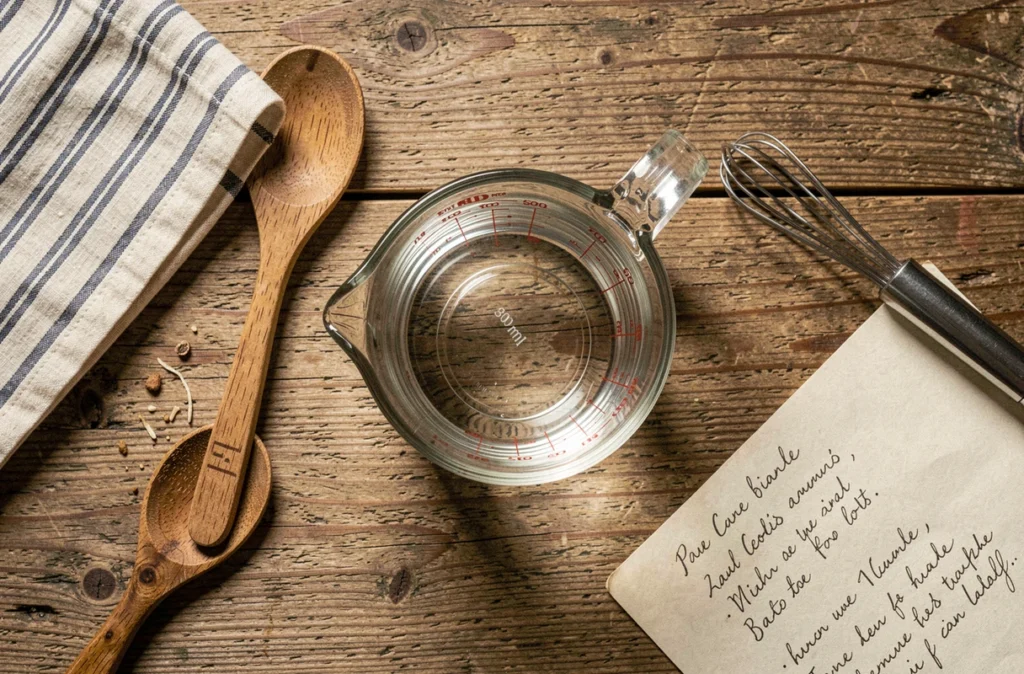
Anglo-Saxon recipes measure volumes in cups. The problem is that the value of a cup varies by country. An American cup does not correspond exactly to a metric cup, and the difference affects conversions to milliliters.
When an American cookbook indicates a certain amount in cups, directly converting it to milliliters with a European measuring cup can introduce a discrepancy. In a recipe requiring 300 ml of liquid, the difference remains moderate. In larger volumes or tight ratios (pastry, jam), it becomes noticeable.
The most effective precaution is to check the origin of the recipe and use a measuring cup graduated in milliliters for all conversions. The milliliter is a standardized unit, accepted with the International System, and does not vary from one country to another.
- Check if the recipe uses the American cup or the metric cup before converting
- Always convert volumes to milliliters for a direct reading on the measuring cup
- In case of doubt about the original unit, test the recipe with a slightly lower volume and adjust
The most useful gesture remains the simplest: place the measuring cup flat, read the graduation at the level of the meniscus, and divide by 1,000 to obtain the volume in liters. For 300 ml, the result will always be 0.3 liters, regardless of the recipe.