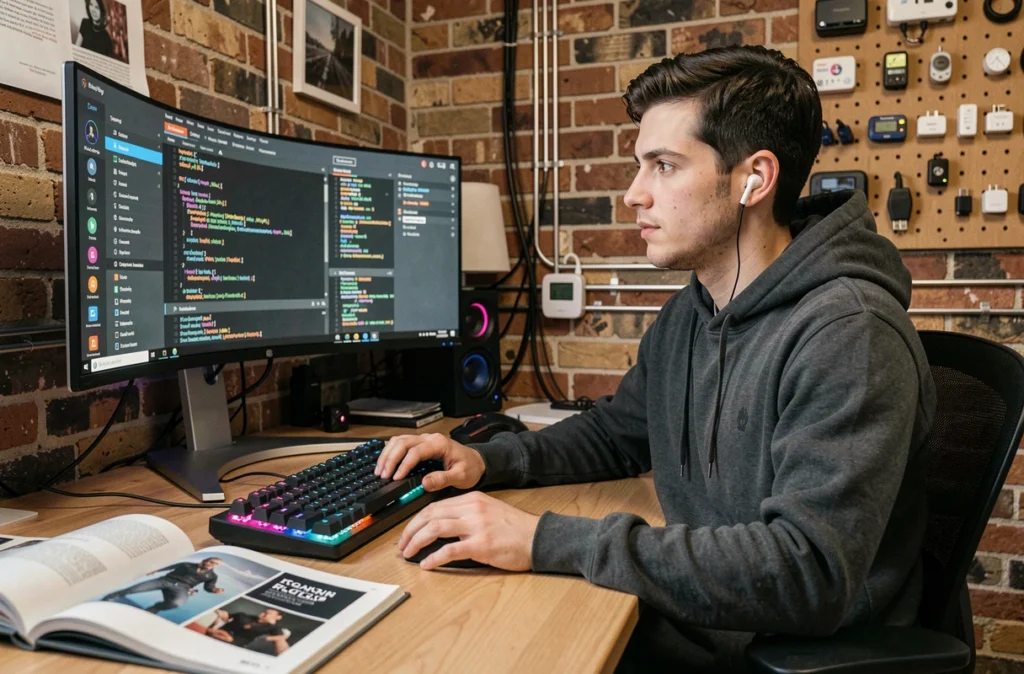
The geek and high-tech culture evolves at the pace of industrial cycles, software disruptions, and new digital consumption habits. Since 2024-2025, several structuring trends are reshaping the landscape for computer enthusiasts, from gaming hardware to office accessories, including the dematerialization of content and AI-powered tools.
Gaming Hardware Market: A Recovery After Post-Covid Saturation
After several years of decline, the segment of gaming PCs and associated accessories (mechanical keyboards, mice, monitors, VR headsets) is on the rise again. The 2026 Jahresreport from the German gaming industry association “game” confirms this trend: the accessories sub-market shows double-digit growth after a long phase of contraction.
This recovery is explained by the renewal of setups following the component shortage, as well as the arrival of new generations of graphics cards and processors. Computer enthusiasts who had postponed their purchases are investing again in high-performance setups. The resources available on the official Geeks and The City website allow tracking these developments product by product.
Hardware is no longer limited to the classic tower case. Mini-PCs are gaining ground for compact setups, and high refresh rate monitors are becoming standard even outside of pure gaming.
Dematerialization of PC and Console Games: What 91% Digital Sales Change
The shift to all-digital represents a structural change that is often underestimated. In 16 European countries, 91% of video game revenue in 2025 comes from digital sales, compared to only 9% for physical media, according to data reported by Inven Global and NewsTank Culture.
For a computer enthusiast, this statistic has direct consequences on three technical fronts:
- Local storage becomes a full budget item, with AAA games regularly exceeding a hundred gigabytes. A high-capacity NVMe SSD is no longer a luxury but a necessity.
- The quality of the internet connection (fiber, Wi-Fi 6E or 7) conditions the purchasing and updating experience. Insufficient bandwidth turns every patch into a wait of several hours.
- The question of archiving and DRM becomes more acute: without physical media, the longevity of access to games depends entirely on distribution platforms.
This shift also pushes NAS manufacturers and network storage solutions to target individuals more, with simplified interfaces and increased capacities.
Office Accessories and Peripherals: Trends Redefining the Geek Setup
The workstation of the computer enthusiast is no longer just a wired keyboard and mouse. Several categories of peripherals are experiencing a notable revival.
Low-Latency Wireless Mice and Keyboards
Wireless gaming mice have caught up with, or even surpassed, their wired counterparts in terms of responsiveness. Proprietary protocols with high polling rates offer latency below a millisecond. The wire is no longer a guarantee of performance for a gaming mouse.
On the keyboard side, Hall effect magnetic switches allow for actuation point adjustment to the tenth of a millimeter. This technology, reserved for high-end models two years ago, is becoming mainstream in mid-range models.
USB-C Docking Stations and Multiport Hubs
With the generalization of USB-C as the single connector on laptops, docking stations have become a common accessory. They allow connecting an external monitor, keyboard, mouse, hard drive, and Ethernet connection via a single cable. A well-chosen USB-C hub radically simplifies the portable setup for both work and leisure.
Local Artificial Intelligence: When the Geek PC Becomes an Inference Station
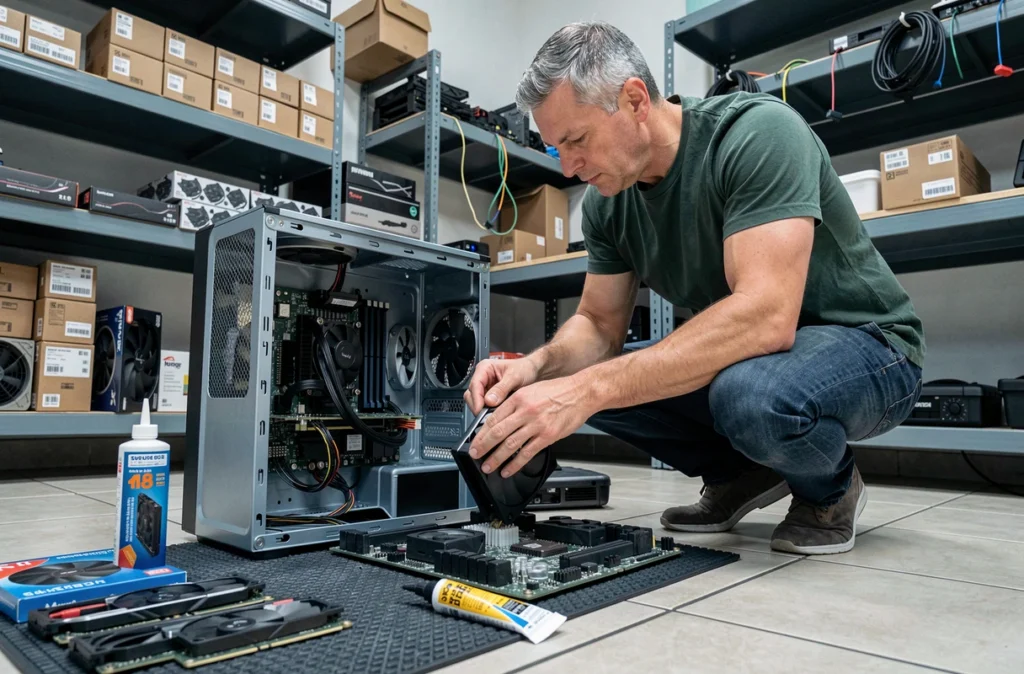
Generative AI is no longer limited to cloud services. A fundamental trend is pushing enthusiasts to run language and image generation models directly on their machines, locally.
This practice, known as local inference, requires a graphics card with sufficient VRAM (dedicated video memory). Open-source models like LLaMA or Stable Diffusion work on consumer GPUs, provided there is at least 8 GB of VRAM for usable results.
The benefits for the computer enthusiast are threefold: data control (no information leaves the machine), fine customization of models, and no subscription costs. The downside: power consumption increases significantly, and the noise of fans under load reminds us that the PC remains primarily a thermal machine.
Motherboard manufacturers are now integrating dedicated connectors and optimized BIOS for this type of use, a sign that local inference is no longer a niche.
USB Drives, Tablets, and Tech Gadgets: Evolving Geek Gifts
The classics of high-tech gifts for computer enthusiasts are also being renewed. Hardware-encrypted USB drives are gaining popularity in light of cybersecurity concerns. Tablets, long confined to content consumption, now serve as a second screen for developers or as a surface for synchronized handwritten notes.
A good geek gift in 2025-2026 is not limited to a trivial gadget. It fits into an ecosystem: compatibility with the existing setup, daily utility, product durability. The useful tech gift is gradually replacing the disposable gadget.
The hardware market, content dematerialization, local AI, and the evolution of peripherals create a landscape where computer enthusiasts have more technical choices than ever, but where each purchase requires consideration of compatibility and longevity. The next wave of hardware renewal, driven by the computational needs of AI and connectivity standards (USB4, Wi-Fi 7, PCIe 5.0), is already on the horizon.